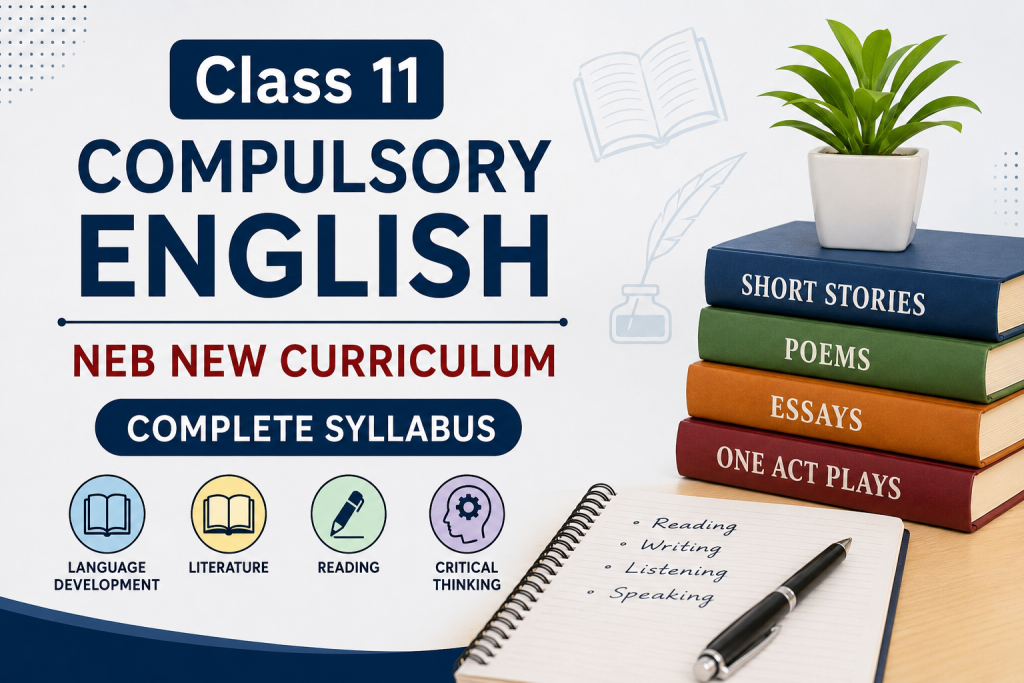

Class 11 Compulsory English Syllabus(NEB New Curriculum) – Complete Guide
The National Examination Board (NEB) has introduced an updated curriculum for Class 11 Compulsory English that focuses on developing students’ communication skills, critical thinking, creativity, and appreciation of literature. The syllabus is divided into two major sections: Language Development and Literature.
Through this course, students improve their reading, writing, listening, speaking, vocabulary, grammar, and analytical skills while studying a variety of stories, poems, essays, and one-act plays written by renowned national and international authors.
Class 11 Compulsory English Syllabus Overview
The syllabus consists of 20 units under Language Development and 4 literary sections under Literature.
Click Here to See Syallabus of Class 11 Account
Click Here to See Syallabus of Class 11 Economics
Click Here to See Syallabus of Class 11 Nepali
Section I – Language Development
This section aims to improve students’ practical English language skills through real-life topics and activities.
Unit 1: Education and Humanity
Students explore the importance of education, human values, social responsibility, and lifelong learning.
Unit 2: Communication
This unit develops effective communication skills, including verbal and non-verbal communication, listening, speaking, reading, and writing.
Unit 3: Media and Society
Students learn about newspapers, television, radio, digital media, social media, and their influence on society.
Unit 4: History and Culture
This chapter introduces historical events, cultural diversity, traditions, heritage, and the importance of preserving culture.
Unit 5: Life and Love
Students study different aspects of life, emotions, relationships, love, and personal experiences.
Unit 6: Health and Exercise
This unit emphasizes healthy lifestyles, balanced diets, physical exercise, mental health, and overall well-being.
Unit 7: Ecology and Development
Students learn about environmental conservation, biodiversity, sustainable development, pollution, and climate change.
Unit 8: Humour and Satire
This chapter explores humorous and satirical writings while helping students understand irony, wit, and social criticism.
Unit 9: Democracy and Human Rights
Topics include democracy, equality, freedom, justice, citizenship, and fundamental human rights.
Unit 10: Home Life and Family Relationship
Students discuss family values, responsibilities, interpersonal relationships, and social harmony.
Unit 11: Arts and Creation
This chapter introduces different forms of art, creativity, literature, music, painting, architecture, and cultural expression.
Unit 12: Fantasy
Students read imaginative texts that develop creativity, imagination, and analytical thinking.
Unit 13: Career and Entrepreneurship
This unit focuses on career planning, entrepreneurship, leadership, innovation, and employment opportunities.
Unit 14: Power and Politics
Students examine political systems, leadership, governance, and the impact of power on society.
Unit 15: War and Peace
Topics include conflict, peacebuilding, international cooperation, and the importance of harmony.
Unit 16: Critical Thinking
Students develop reasoning, problem-solving, logical analysis, and decision-making skills.
Unit 17: Globalisation and Diaspora
This chapter discusses globalization, migration, cultural exchange, and the experiences of diaspora communities.
Unit 18: Immigration and Identity
Students explore immigration, identity, multiculturalism, citizenship, and cultural diversity.
Unit 19: Travel and Tourism
Topics include tourism, travel experiences, hospitality, cultural exchange, and economic development.
Unit 20: Science and Technology
Students learn about scientific discoveries, technological innovation, artificial intelligence, communication technology, and their impact on modern life.
Section II – Literature
The literature section introduces students to world-famous literary works that develop reading comprehension, literary appreciation, vocabulary, and critical thinking.
Unit 1: Short Stories
Students study the following short stories:
- The Selfish Giant — Oscar Wilde
- The Oval Portrait — Edgar Allan Poe
- God Sees the Truth but Waits — Leo Tolstoy
- The Wish — Roald Dahl
- Civil Peace — Chinua Achebe
- Two Little Soldiers — Guy de Maupassant
- An Astrologer’s Day — R.K. Narayan
These stories explore themes such as kindness, justice, fate, war, love, sacrifice, morality, and human nature.
Unit 2: Poems
The prescribed poems are:
- Corona Says — Vishnu S. Rai
- A Red, Red Rose — Robert Burns
- All the World’s a Stage — William Shakespeare
- Who are you, little i? — E. E. Cummings
- The Gift in Wartime — Tran Mong Tu
Students learn poetic devices, symbolism, imagery, emotions, rhythm, and themes expressed through poetry.
Unit 3: Essays
Students read and analyze the following essays:
- Sharing Tradition — Frank LaPena
- How to Live Before You Die — Steve Jobs
- What I Require from Life — J. B. S. Haldane
- What is Poverty? — Jo Goodwin Parker
- Scientific Research is a Token of Humankind’s Survival — Vladimir Keilis-Borok
These essays discuss culture, motivation, science, poverty, education, personal success, and human civilization.
Unit 4: One-Act Plays
The syllabus includes three one-act plays:
- Trifles — Susan Glaspell
- A Sunny Morning — Serafín and Joaquín Álvarez Quintero
- Refund — Fritz Karinthy
These plays help students understand dramatic techniques, characterization, dialogue, conflict, and stage presentation.
Preparation Tips for NEB Examination
- Read every Language Development unit carefully.
- Study all prescribed stories, poems, essays, and plays thoroughly.
- Practice grammar and vocabulary regularly.
- Solve reading comprehension exercises.
- Write summaries, paragraphs, essays, letters, and reports.
- Practice previous years’ NEB questions and model sets.
- Revise literary themes, characters, poetic devices, and important quotations.
Conclusion
The Class 11 Compulsory English syllabus under the NEB New Curriculum is designed to develop students into confident English users with strong communication skills and a deep understanding of literature. By studying both the Language Development and Literature sections consistently, students can perform well in the NEB examination while improving the language skills required for higher education and future careers.

Ramesh Pokhrel is an educator, entrepreneur, and educational content creator from Nepal. He teaches Accountancy, Economics, Business Studies, and other management subjects with a practical, student-focused approach. As the founder of Mastersaab, he is dedicated to making quality education accessible through technology, comprehensive study materials, and engaging digital content. His mission is to empower students with the knowledge and skills they need to achieve academic and career success.