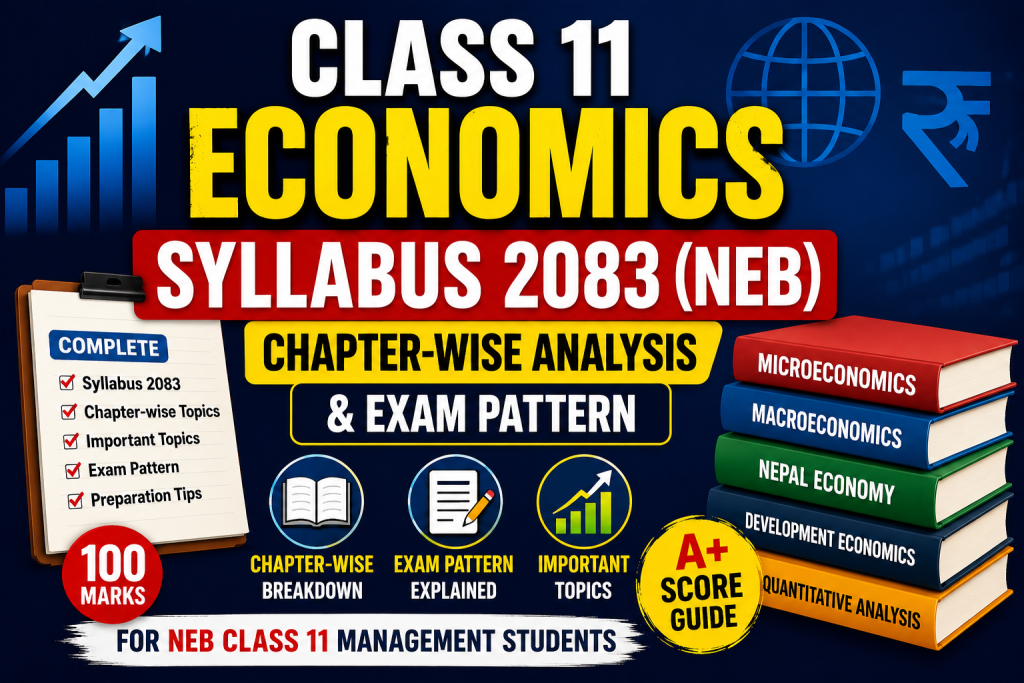

Class 11 Economics Syllabus 2083 (NEB)
Economics is one of the most important subjects for Class 11 Management students under the National Examination Board (NEB), Nepal. It helps students understand how individuals, businesses, and governments make economic decisions. Besides scoring good marks in board examinations, Economics also builds a strong foundation for higher studies in Business, Management, Finance, Banking, Public Policy, and Economics.
This article provides a complete overview of the Class 11 Economics Syllabus 2083, including chapter-wise topics, exam pattern, marks distribution, and effective preparation strategies.
| Particular | Details |
|---|---|
| Subject | Economics |
| Level | Class 11 (NEB) |
| Curriculum | 2083 |
| Theory Marks | 75 |
| Practical / Project | 25 |
| Total Marks | 100 |
| Total Chapters | 6 |
| Total Teaching Hours | 120 Hours |
Chapter-wise Economics Syllabus 2083
| Chapter | Topics | Hours |
|---|---|---|
| Chapter 1 | Basic Concept of Economics and Allocation of Resources | 8 |
| Chapter 2 | Microeconomics | 38 |
| Chapter 3 | Macroeconomics | 25 |
| Chapter 4 | Development Economics | 8 |
| Chapter 5 | Economy of Nepal | 28 |
| Chapter 6 | Quantitative Analysis for Economics | 13 |
Chapter 1: Basic Concept of Economics and Allocation of Resources (8 Hours)
This chapter introduces students to the fundamental concepts of economics. It explains different definitions of economics, various branches of economics, factors of production, and different types of goods and services.
Topics Covered
- Definition of Economics
- Adam Smith
- Alfred Marshall
- Lionel Robbins
- Positive and Normative Economics
- Microeconomics vs Macroeconomics
- Types of Goods and Services
- Normal Goods
- Giffen Goods
- Inferior Goods
- Substitute Goods
- Complementary Goods
- Private Goods
- Public Goods
- Economic Goods
- Free Goods
- Factors of Production
- Land
- Labour
- Capital
- Organization (Entrepreneur)
Chapter 2: Microeconomics (38 Hours)
This is the largest and most important chapter of the syllabus. Students should spend the maximum preparation time on this unit.
Unit 2.1 Demand, Supply and Market Equilibrium
Topics include:
- Meaning of Demand
- Demand Function
- Law of Demand
- Determinants of Demand
- Movement Along Demand Curve
- Shift in Demand Curve
Supply
- Meaning of Supply
- Supply Function
- Law of Supply
- Determinants of Supply
- Supply Curve
- Shift in Supply Curve
Market Equilibrium
- Equilibrium Price
- Equilibrium Quantity
- Effects of Demand and Supply Changes
Unit 2.2 Elasticity of Demand and Supply
Students study:
- Price Elasticity of Demand
- Income Elasticity
- Cross Elasticity
Types of Elasticity
- Perfectly Elastic
- Perfectly Inelastic
- Relatively Elastic
- Relatively Inelastic
- Unitary Elastic
Elasticity of Supply
- Concept
- Types
- Determinants
Unit 2.3 Consumer Behaviour
Topics include:
- Cardinal Utility
- Total Utility
- Marginal Utility
- Law of Diminishing Marginal Utility
- Law of Substitution (Equi-marginal Utility)
- Consumer’s Surplus
- Producer’s Surplus
Unit 2.4 Theory of Production
Students learn
- Production Function
- Short Run and Long Run
- Total Product
- Average Product
- Marginal Product
- Law of Variable Proportions
- Returns to Scale
Chapter 3: Macroeconomics (25 Hours)
Macroeconomics studies the economy as a whole.
Topics Covered
Introduction
- Meaning of Macroeconomics
- Macroeconomic Variables
- Closed Economy
- Open Economy
National Income Accounting
Concepts of
- GDP
- GNP
- NNP
- National Income
- Personal Income
- Disposable Income
- Per Capita Income
Other Topics
- Nominal GDP
- Real GDP
- GDP Deflator
- Measurement of National Income
- Product Method
- Income Method
- Expenditure Method
- Difficulties in Measuring National Income in Nepal
Money and Inflation
- Meaning of Money
- Functions of Money
- Forms of Money
- Narrow Money
- Broad Money
- Fisher’s Quantity Theory of Money
- Inflation
- Deflation
- Causes and Consequences
Chapter 4: Development Economics (8 Hours)
Students learn the concept of economic growth and development.
Topics include:
- Economic Growth
- Economic Development
- Indicators of Development
- Characteristics of Developing Countries
- Capital Formation
- Capital Formation Process
Chapter 5: Economy of Nepal (28 Hours)
This chapter focuses on Nepal’s economic structure and current economic issues.
Review of Nepalese Economy
Topics
- Contemporary Features
- Provincial and Central Government Indicators
Natural Resources
- Water Resources
- Forest Resources
- Mineral Resources
- Climate Change
- Natural Resource Management
Agriculture
Topics
- Characteristics
- Modernization
- Commercialization
- Agricultural Finance
- Agricultural Marketing
Manufacturing and Tourism
Topics
- Industrial Development
- Types of Industry
- Industrial Problems
- Tourism Industry
- Prospects
- Challenges
- Solutions
Transportation and Communication
Topics
- Role in Economic Development
- Means of Transportation
- Means of Communication
- Current Status
Chapter 6: Quantitative Analysis for Economics (13 Hours)
This chapter introduces mathematical tools used in economics.
Topics include
- Importance of Mathematics
- Equation of Straight Line
- Differential Calculus
- Simple Derivatives
- Partial Derivatives
Class 11 Economics Exam Pattern (NEB)
The theory examination carries 75 marks and is divided into three sections.
| Section | Questions | Marks per Question | Total Marks |
|---|---|---|---|
| Very Short Answer | 11 | 1 | 11 |
| Short Answer | 8 (Internal choice in 2) | 5 | 40 |
| Long Answer | 3 (One internal choice) | 8 | 24 |
| Total | 22 | 75 |
Chapter-wise Preparation Strategy
| Chapter | Preparation Priority | Strategy |
|---|---|---|
| Basic Concepts | Medium | Focus on definitions, comparisons, and factors of production. |
| Microeconomics | Very High | Practice graphs, numerical problems, laws, elasticity, and market equilibrium. |
| Macroeconomics | High | Memorize national income concepts, GDP calculations, and inflation-related topics. |
| Development Economics | Medium | Learn indicators, characteristics, and capital formation concepts. |
| Economy of Nepal | Very High | Prepare current economic issues, industries, agriculture, and natural resources. |
| Quantitative Analysis | High | Solve mathematical problems regularly and practice derivations. |
Smart Study Plan
To score excellent marks in Economics:
- Read each chapter thoroughly before solving questions.
- Memorize important definitions and economic terms.
- Practice drawing demand and supply curves neatly.
- Revise numerical questions on elasticity and national income.
- Create short notes for formulas and important concepts.
- Practice previous years’ board questions.
- Solve model sets under exam conditions.
- Revise difficult chapters multiple times before examinations.
High-Scoring Topics
Give extra attention to:
- Demand and Supply
- Market Equilibrium
- Elasticity of Demand
- Consumer Behaviour
- Production Theory
- National Income
- GDP and GNP
- Inflation and Deflation
- Nepalese Economy
- Agriculture and Tourism
- Mathematical Problems
- Long Answer Conceptual Questions
Final Words
The Class 11 Economics Syllabus 2083 provides students with a comprehensive understanding of both microeconomics and macroeconomics, along with insights into Nepal’s economy and the mathematical tools used in economic analysis. Since Microeconomics (38 hours) and Economy of Nepal (28 hours) together account for more than half of the teaching hours, students should prioritize these chapters while also maintaining a balanced revision schedule.
With consistent study, regular numerical practice, and thorough revision of concepts, students can confidently aim for excellent performance in the NEB Class 11 Economics examination.
Also View NEB Class 11 Account Syllabus and Notes.

Ramesh Pokhrel is an educator, entrepreneur, and educational content creator from Nepal. He teaches Accountancy, Economics, Business Studies, and other management subjects with a practical, student-focused approach. As the founder of Mastersaab, he is dedicated to making quality education accessible through technology, comprehensive study materials, and engaging digital content. His mission is to empower students with the knowledge and skills they need to achieve academic and career success.